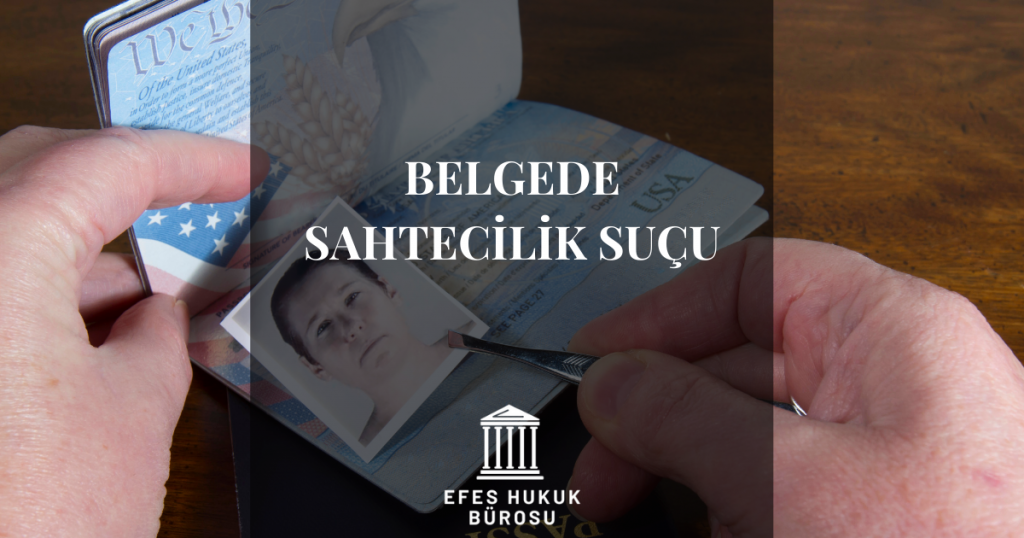
Forgery of Documents | Izmir Criminal Lawyer
1. The Concept of Documents and Forgery:
The word "belge" (document) is used in Arabic as the equivalent of "evrak" (paper). "Evrak" means written paper or sheets of paper. Forgery, on the other hand, is the act of deliberately altering, changing, or presenting something (in this case, documents) differently than it is, with the intention of deceiving someone else.
2. Common Characteristics That Documents Should Have:
- a. The Document Must Be in Writing: Writing is a suitable means of recording a declaration or statement of intent.
- b. The Document Must Constitute Evidence: For any written text to qualify as a document, it must prove an event or a right.
- c. Authenticity of the Document Must Be Determined: It must be established that the written declaration of intent belongs to a specific person or authority. Authenticity can be determined from the signature or its content.
- d. It Must Have Legal Consequences: For a document to constitute evidence, it must be free from defects in terms of form and content.
3. Legal Regulation:
Turkish Penal Code‘The legal provisions regarding the crime of forgery of (private) documents, as regulated in Article 207 and subsequent articles of the law, are as follows:
Article 207- (1) A person who forges a private document or alters a genuine private document in a way that deceives others and uses it shall be punished with imprisonment from one to three years. (2) A person who knowingly uses a forged private document shall also be punished according to the provisions of the above paragraph.
Article 208 – (1) A person who alters, destroys or conceals a genuine private document shall be punished with imprisonment from one to three years.
Article 209- (1) A person who fills in a signed and partially or completely blank paper, which was given to him to be filled in and used in a specific manner, in a way different from the reason for its being given, shall be punished with imprisonment from three months to one year upon complaint. A person who unlawfully obtains or possesses a signed and partially or completely blank paper and fills it in a way that will produce legal consequences shall be punished according to the provisions of forgery of documents.
4. Documents Constituting the Subject Matter of the Crime of Forgery:
Turkish Penal Code Article 210– (1) If the subject of the crime of forgery of a private document is a bill of exchange payable to order or bearer, a document representing goods, a share certificate, a bond or a will, the provisions relating to the crime of forgery of an official document shall apply. A physician, dentist, pharmacist, midwife, nurse or other health professional who prepares a false document shall be punished with imprisonment from three months to one year. If the prepared document provides an unfair advantage to a person or has the nature of causing harm to the public or individuals, the punishment shall be determined according to the provisions of forgery of an official document.
ÖTo summarize;
- When examining the relevant legal provisions, the first paragraph defines "forgery of a private document," and the second paragraph defines "knowingly using a forged private document." Therefore, for the crime of forgery of a private document to be considered, the document must be altered through additions, deletions, or scratching before use. Intent is a key element in committing the crime. The individual must commit the crime knowingly and willingly; negligence is not possible.
- The document in question is a private document, unofficial, and can be prepared in writing. A crime is committed if a private document is forged or altered in a way that deceives others.
- The document that is the subject of the crime of forgery of a private document can be prepared and used as evidence by anyone. Therefore, the crime can be committed by anyone; it is not specific to any one person.
- The document must necessarily pose a risk of harm. Forgery of a private document must have the potential to cause harm to the public. The important thing is the possibility of harm; if there is no possibility of harm, a crime has not been committed.
5. How does a crime occur?
Additions or deletions to a document must alter its legal evidentiary value. These changes must result in a change to the legal status or right expressed in the private document. Examples of actions constituting this crime include altering or adding text to a private document, deleting or changing signatures and dates, and modifying or using a private document.
Private documents are similar to official documents in terms of their legal consequences. However, the law prescribes a more severe penalty for the crime of forgery of official documents. This is because it considers official documents to be of higher importance than private documents. In addition, while only public officials can commit the crime of forgery of official documents, anyone can be the perpetrator of the crime of forgery of (private) documents.
6. Statute of Limitations Provisions:
The crime of forgery of a private document is not a crime that requires a complaint. Therefore, there is no time limit for filing a complaint. However, since the statute of limitations for the crime of forgery of a private document is eight years, if the crime is reported to the prosecutor's office within eight years, the prosecutor's office will initiate an investigation. Regardless of when the complaint is filed, the complainant can participate in the criminal case as an intervenor..
7. Supreme Court Decisions:
- Simultaneous Commission of the Crimes of Forgery of Private Documents and Forgery of Public Documents
The defendant obtained fraudulent subscription agreements from the victim companies, Turkcell and Türk Telekom, for mobile phones, landline phones, and internet lines. In addition, the defendant used a forged identity card in the victim's name to obtain a personal loan from a bank using a credit deposit account. Furthermore, the defendant established a taxpayer registration in the victim's name at the tax office and registered two motorcycles, thereby facilitating tax assessments.
The defendant was tried by the high criminal court for the crimes of misuse of bank or credit cards, forgery of official documents, and forgery of private documents. The defendant was convicted, and both the defendant, the plaintiff, and the victim's lawyers filed appeals against the verdict.
The Court of Cassation stated that the lower court's decision was made without discussing whether the defendant's actions constituted the crime defined in Article 56 of the Electronic Communications Law. Furthermore, it was determined that the court's decision failed to consider that the defendant's actions, taken as a whole, would constitute separate crimes for each victim. The court ruled to overturn the lower court's decision, which was based on insufficient reasoning. (Court of Cassation, 8th Criminal Chamber, Case No. 2018/9065, Decision No. 2019/6094)
- Acquittal on charges of forgery of a private document.
The participant was working at the PTT (Turkish Post Office) General Directorate at the time of the incident. The participant obtained three health insurance cards in his wife's name. When each card ran out of pages, he returned it to his workplace with a receipt, and continued using it after receiving a new one. When the pages of the first health insurance card ran out, he obtained a second card, and a third health insurance card was issued to the institution. The participant returned the third card to the institution belatedly.
It was determined that the complainant, using the first page of the health record containing a photograph, had a prescription issued, tests performed, and an invoice for 100.11 TL prepared in the name of her deceased spouse, as if the defendant, an internal medicine specialist, had examined her at the Private Gelişim Medical Center. This invoice was sent to the institution where the complainant worked. Institution officials investigated and determined that the examination and tests were performed after the death.
The defendant was tried by the High Criminal Court on charges of aggravated fraud and forgery of official documents. In their defense, the defendants stated that they were admitted upon the patient's arrival for examination, that they had no duty to ask for identification, and that they had no intent to commit a crime. The defendant was acquitted, and the plaintiff's lawyer filed an appeal against the decision.
The Court of Cassation ruled that there was insufficient evidence to prove that the deceased's health insurance card was knowingly used by the defendants, and since no evidence contradicting the defendants' defense was obtained, the lower court's decision was found to be correct. Therefore, the court upheld the lower court's decision. (Court of Cassation, 15th Criminal Chamber, Case No. 2017/4274, Decision No. 2019/4117)
To obtain legal advice on this matter Contact page.
Other works that may be of interest to you;
- What does "complainant" mean?
- What does "defendant" mean?
- What is the presumption of innocence?
- What is a repeat offence?
- What is the Right to Remain Silent?
- What is GBT?
- What is confiscation?
- What is Dismissal of a Case?
- What is HAGB?
- What is conscious negligence?
- What is acquittal?
- What are cataloged crimes?
- What is a Medical Report? How to Obtain One?
- What does recurrence mean?
- The Crime and Punishment of Qualified Fraud
- What is stalking?
- Crime of Obscenity
- The Crime of Insulting Religious Values
- The Crime of Stalking
- What is the crime of insult?
- Illegal Gambling Crime
- Crime of Using Narcotic and Stimulant Substances
- Conspiracy to Commit a Crime
- Threat Crime & Punishment
- What is the crime of looting?
- Breach of Trust Crime
- Perjury
- Inciting hatred and hostility or humiliation among the public
- Crime of Forgery of Documents
- Breach of Trust Crime
- The Penalty for Reading Coffee Grounds
- Receiving a Notification from the Courthouse
- How to Read a Criminal Record?
- What is a judicial fine?
- Expedited Trial Procedure
- HAGB (Suspension of the Pronouncement of the Verdict) and Postponement of the Prison Sentence
- Quick Trial Procedure in Criminal Procedure
- Crimes Subject to Expedited Trial
- Crimes Subject to Mediation
- Cases Requiring Compulsory Legal Representation
- Types of Prisons
- Objection to the Traffic Penalty
- Search Warrant
- Factors Affecting Defectiveness
- Prevention Search
- Arrest Warrant
- Filing a Criminal Complaint with the Prosecutor's Office
- Discretionary Reduction in Criminal Proceedings
- Detention
- How Long Do Criminal Trials Last?
- How many years is life imprisonment?

Address: Nergis Neighborhood, Girne Boulevard No: 83, Floor 2, Apartment 2, Karşıyaka, İzmir
E-mail: info@efeshukuk.com
Phone: +90 534 415 52 56