
GDPR Administrative and Criminal Sanctions | GDPR Lawyer | Izmir Lawyer | Izmir Law Office
The processes of personal data processing and protection are subject to much stricter controls in 2026, along with technological advancements. Administrative and penal sanctions regulated under Law No. 6698 aim to reinforce the responsibilities of data controllers regarding informing data, ensuring data security, and complying with board decisions. As Efes Law Office, based in Izmir, we manage businesses' GDPR compliance processes with professional rigor, minimizing legal risks.
The administrative fines stipulated in Article 18 of the law for the offenses listed have reached their highest level for 2026, in line with the revaluation rates published annually. During this period, not only monetary fines but also imprisonment sentences under the Turkish Penal Code pose a significant risk for data controllers. Furthermore, the 2024 legal amendment designating Administrative Courts as the appeals body against administrative sanctions marks a new era in terms of the right to seek redress. In this guide, you can find all the critical details, from current fine amounts to the changing jurisdiction of the courts.
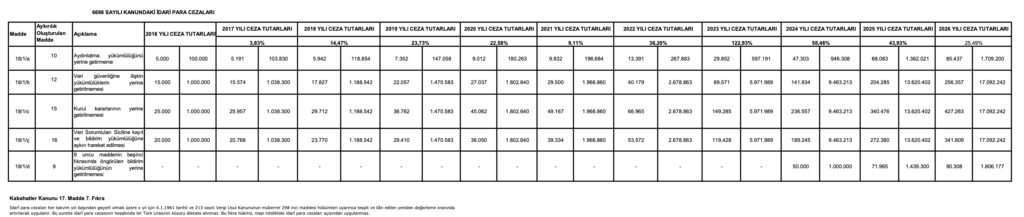
Administrative Fines Under Law No. 6698 and Current Rates for 2026
Kişisel verilerin korunması mevzuatında kabahatler, kanunun 18. maddesi ile düzenlenmiştir. Kanunun yürürlüğe girdiği tarihten itibaren her yıl yayınlanan yeniden değerleme oranları, idari para cezası bedellerinde düzenli artışlara neden olmuştur. 2026 yılı için belirlenen %25,49 oranındaki artışla birlikte, veri sorumlularının karşı karşıya olduğu mali riskler şu ana kadarki en yüksek seviyesine ulaşmıştır.
The table below shows the current administrative fine limits that will be applied as of 2026:
| Type of Offense (Article 18) | Lower Limit (2026) | Upper Limit (2026) |
| Violation of the Obligation to Inform | 86,437 TL | 1,709,200 TL |
| Violation of Data Security Obligations | 256,357 TL | 17,092,242 TL |
| Violation of Decisions Made by the Board | 427,263 TL | 17,092,242 TL |
| Violation of VERBİS Registration and Notification Obligation | 341,809 TL | 17,092,242 TL |
For companies operating in the Izmir region, it is vital that they bring their data processing processes into compliance with 2026 standards to avoid facing these severe penalties in areas with high commercial activity. If these offenses, specified in Article 18 of the law, are committed within public institutions, disciplinary measures are applied to the relevant officials upon notification from the Board, and the outcome is reported to the Board.
Personal Data Crimes and Imprisonment Penalties Under the Turkish Penal Code
Data protection law encompasses not only financial penalties but also imprisonment. In cases of data breaches, investigations conducted under the Turkish Penal Code can have irreversible consequences for data controllers and data processors. Businesses must fully implement technical and administrative measures to manage these risks.
Unlawful Recording and Acquisition of Data
Those who unlawfully record personal data are subject to imprisonment for one to three years. This penalty is increased by half if the recorded data relates to individuals' political, philosophical, or religious views, racial origins, moral inclinations, sexual lives, health status, or trade union affiliations (special categories of data).
Those who unlawfully disclose, disseminate, or obtain data belonging to another person shall be sentenced to imprisonment for two to four years. If the subject matter of the crime is a statement or image recorded in accordance with the Code of Criminal Procedure, the penalty shall be increased by one-fold.
The Crime of Failure to Destroy Data and Aggravating Circumstances
Failure by those obligated to delete data from the system, even after legal deadlines have expired, to do so may result in imprisonment for one to two years. If the data in question is content that needs to be destroyed in relation to legal proceedings, the penalty will be increased by one-third.
The aggravating circumstances of the crime are as follows:
- The crime is committed by a public official and through the abuse of authority granted by their position.
- Processing something by taking advantage of the ease provided by a particular profession or art.
In these cases, the penalty is increased by half. Furthermore, crimes related to the recording, dissemination, and failure to destroy personal data are not subject to complaint but are investigated ex officio by the relevant authorities. In cases where such crimes are committed, specific security measures are also applied to legal entities.
A New Legal Appeal Route Against Administrative Fines Under the Personal Data Protection Law: Administrative Courts
The legal avenue for appealing against administrative fines imposed by the Personal Data Protection Board underwent a fundamental change with the legislative amendment in 2024. Prior to this date, appeals against these fines were made to the Magistrates' Courts; however, as a result of the new legal amendment, the competent and authorized judicial body is now the Administrative Courts.
This change necessitates that defense strategies for data controllers be entirely shaped according to administrative judicial procedure. From 2026 onwards, in appeals against high-amount administrative fines, the illegality of the administrative act must be argued in terms of authority, form, reason, subject matter, and purpose. Following the precedents of local courts, particularly in the İzmir region, is of great importance for businesses to avoid losing their rights.
Considering the current lower and upper limits of administrative fines in 2026, managing the litigation process before the Administrative Court with professional legal support is the most effective way for businesses to protect their financial future.
For our other articles we have prepared under the Personal Data Protection Law;
- Exemption from VERBİS Registration
- How is the annual number of employees calculated for KVKK (Personal Data Protection Law) registration purposes?
- How should the total financial balance be calculated in relation to the Personal Data Protection Law (KVKK) registration?
- What are the reasons for processing personal data listed in the Data Controllers Registry?

Address: Nergis Neighborhood, Girne Boulevard No: 83, Floor 2, Apartment 2, Karşıyaka, İzmir
E-mail: info@efeshukuk.com
Phone: +90 534 415 52 56